BreathiZen blog
How To Read a Supplement Label
Most of what a supplement label tells you is in the gaps. Read it in this order and the gaps show up fast.
Method
Read it in this order
A supplement label is designed to be read in a particular order: brand name first, then the claim, then a picture, then the ingredient list somewhere small. Reading it in that order is how people end up buying things they would not have bought.
Read it backwards instead. Start with the numbers, which are the hardest thing to fake, and finish with the claims, which are the easiest. Six things, in this order, and most products are settled by the first one.
The first check
1. The amounts
Find the milligram figures. Not the ingredient names — the numbers next to them.
There are three versions of this and they are not equally good. The best is a full panel with an amount against every ingredient. The acceptable middle is a declared proprietary blend with a total weight and the ingredients listed in descending order, which at least tells you the size of the thing you cannot see inside. The weakest version is a list of names with no numbers anywhere and no blend declared, which tells you nothing about strength at all.
If a product is in the third group, you have learned the most important thing about it in ten seconds, and you can decide on that basis alone whether to keep reading. Most people never look, which is why the third group exists.
Our own label is in the third group
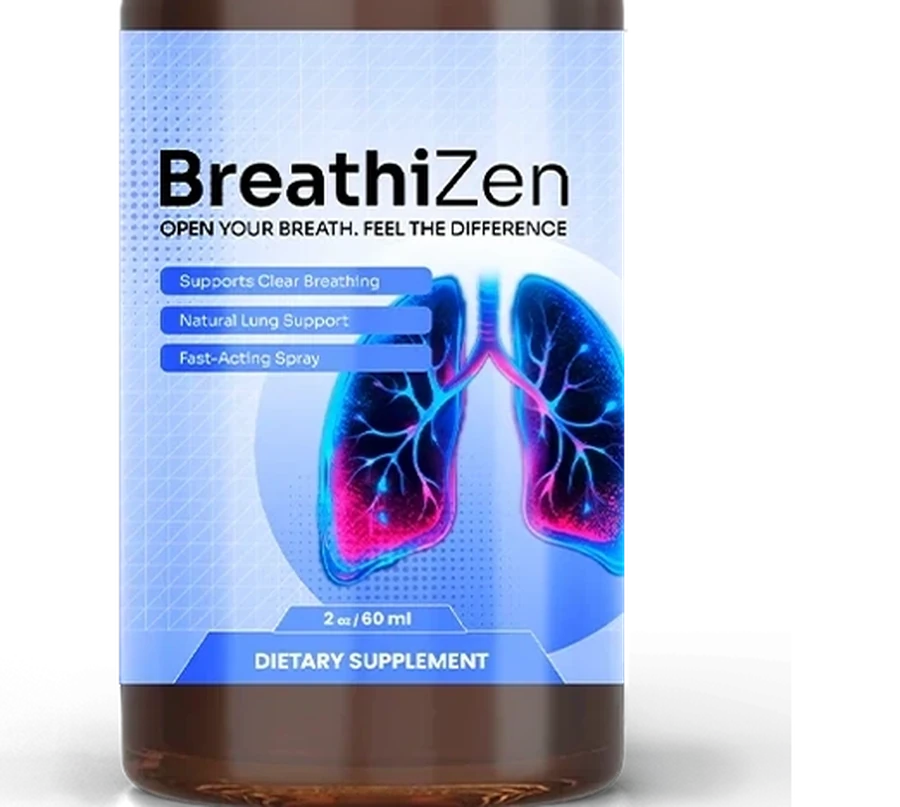
BreathiZen names ten ingredients and publishes no amount for any of them. We are not going to write a post about label-reading and quietly leave that out.
The second check
2. The serving size
Two numbers, and the relationship between them: how much is in one serving, and how many servings are in the container.
The second one is the one that gets left off, and it is the one that tells you what a bottle actually costs to use. A $40 bottle with 30 servings is $1.33 a day. A $60 bottle with 100 servings is $0.60. The cheaper bottle is the more expensive product, and the label is not going to do that sum for you.
Where a servings count is missing, the bottle size and the serving size will usually let you work it out. BreathiZen, for instance, prints 2 oz / 60 ml and a serving of 4 pumps (0.60 mL), which is about a hundred servings — a figure the seller does not publish and we calculate openly rather than quoting as fact.
Watch for serving sizes above one unit, too. “Two capsules” halves the servings in a bottle relative to what most people assume when they glance at a capsule count.
The third check
3. The other ingredients line
The “other ingredients” line is the one nobody reads and it is often the most informative thing on a label.
It tells you the carrier, which for a liquid is usually water plus glycerin or alcohol. It tells you preservatives. It tells you sweeteners, flavourings and, on a capsule, what the shell is made of — which matters if you are vegetarian. It is also where fillers show up.
An absent “other ingredients” line on a liquid product is a genuine gap, because a liquid cannot exist without a carrier. Something is in there holding the extracts in suspension; the label just is not saying what.
On the BreathiZen label, no such line appears in the material we were given. That is one of the eight gaps listed on our label page.
The fourth check
4. The claims
| What it says | What that means |
|---|---|
| Supports / promotes / helps maintain | A structure/function claim. Legal on a supplement, and deliberately modest |
| Treats / cures / prevents a named condition | A disease claim. Not permitted on a dietary supplement label in the US |
| Clinically proven | Ask: proven in what, at what amount, in whom? Usually borrowed from an ingredient study at a different dose |
| Doctor formulated | Check for a full name and credentials. If there is none, it is a phrase |
| FDA approved | Not possible. The FDA is not authorised to approve supplements for safety and effectiveness before they are marketed |
| Made in an FDA-registered facility | True of most US facilities and required. Describes the factory, not the product |
| Natural / pure | Neither has a legal definition on a US supplement label |
The useful habit here is to read a claim and immediately ask what it would take to check it. “Supports clear breathing” is unfalsifiable and legal. “Clinically proven to increase lung capacity by 20%” is checkable, and the absence of a citation next to it tells you everything.
The fifth check
5. The seals
Seals are graphic design. Some of them stand for something real and some of them stand for nothing, and they look identical.
The ones with content describe a process or a fact: GMP is about how a factory is run, Made in USA is about where a bottle was filled, dairy free and vegetarian are about what is not in it. Useful, narrow, checkable in principle.
The ones without content use words that have no legal definition on a US supplement label. “Natural.” “Pure.” “Premium.” A roundel around a word does not create a standard behind it.
And then there is the third kind: a seal that implies a document. “Lab tested”, “third-party verified”, “guaranteed pure”. Those are worth something only if the document is published. A reference number is not a document. We say exactly this about our own “guaranteed pure” seal on the testing page.
The sixth check
6. The contact details
Last, and quickest. Is there a phone number? Is there a physical address? Is there a separate returns address?
This is the cheapest signal on any label and one of the most reliable, because contact details are expensive to staff and easy to omit. A company that publishes a number that answers has made a commitment that a web form does not represent.
Check the refund window at the same time, and check it where you pay rather than where you browse. Note who pays return postage and when the clock starts — at the order or at delivery. Those two details decide whether a guarantee is usable or decorative.
Applied
One label, read line by line
| Check | What the label gives | Verdict |
|---|---|---|
| 1. Amounts | Ten names, no numbers | Fails |
| 2. Serving size | 4 pumps (0.60 mL); servings count not printed | Partial |
| 3. Other ingredients | No line supplied | Fails |
| 4. Claims | Three structure/function claims, no disease claims | Passes |
| 5. Seals | Ten marks; two with nothing behind them | Partial |
| 6. Contact | Phone, office address, separate returns address | Passes |
Two passes, two partial passes and two failures. That is a below-average label attached to an above-average seller, which is an unusual combination and the honest summary of this product.
Extra
Why the front and back of a label disagree
Two things the front of a label is doing
The front panel is marketing and the back panel is disclosure, and they are written by different people for different reasons. The front exists to be recognised across a shop aisle or a browser tab: a name, a colour, an illustration, a short claim. The back exists because the law requires it.
That is why the reading order in this post starts at the back. Anything on the front that matters will also be on the back, expressed more precisely, and anything on the front that is not on the back is telling you about the company's intentions rather than about the product.
A word about pictures
Illustrations on a supplement label are not claims and are not regulated as claims. A glowing pair of lungs, a diagram of an airway, a green leaf: none of them is a statement anyone has to stand behind. They set an expectation that the words are careful not to make, which is precisely why they are there.
The BreathiZen label carries a lung illustration in blue and magenta. It is well drawn. It is also doing a job that the three printed claims are legally prevented from doing, and it is worth noticing that separation the next time you look at any bottle.
What to do with what you find
If a label passes the first check — amounts printed — compare it with another product that also passes. Comparing a disclosed label with an undisclosed one is not a comparison, because one side of it is empty.
If a label fails the first check, the remaining five checks tell you about the company rather than about the formula. That is still useful information, and it is the situation a buyer is in with this product: a below-average label attached to an above-average seller.
Summary
The one-sentence version
Read the numbers before the words, and read the small print before the claim. A label that will not tell you how much of something you are taking has told you what it thinks of your attention, and that is usually the most useful sentence on the whole bottle.
References
Sources
- U.S. Food and Drug Administration. Information for Consumers on Using Dietary Supplements. www.fda.gov. Accessed September 22, 2026.
- NIH Office of Dietary Supplements. Dietary Supplements: What You Need to Know. ods.od.nih.gov. Accessed September 22, 2026.
- NIH Office of Dietary Supplements. Botanical Dietary Supplements: Background Information. ods.od.nih.gov. Accessed September 22, 2026.
Order BreathiZen from the official page
Published prices run $49 to $89 a bottle with a 60-day money-back window and a U.S. order desk for tracking and refunds.
60-day money-back window · ships from inside the US