A named amount
Milligrams per serving, on the label, where you can read it before you buy. This is the check that eliminates most products in about ten seconds.
BreathiZen blog
Mullein is on almost every lung supplement sold in the United States. That is a fact about marketing as much as about plants.
The plant
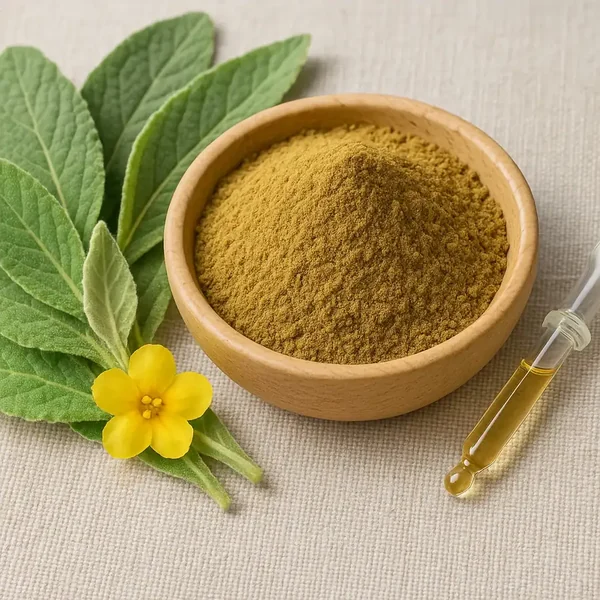
Mullein is Verbascum thapsus, a biennial plant that grows waist-high on roadsides and waste ground across most of North America and Europe. In its first year it is a rosette of soft, grey-green leaves covered in fine hairs. In its second it sends up a single flowering spike that can reach two metres.
The leaves are the part used. Dried and brewed, they make a mild tea that has been drunk for chest complaints for a very long time in a lot of different places — which is, on its own, a meaningful fact about a plant, and a much smaller fact than it is usually made to sound.
It is worth knowing that mullein is not rare, not difficult to grow and not expensive. It is a common weed. That has nothing to do with whether it works, but it does explain why it turns up on every label in this category: it is cheap, it is recognisable and its name signals “lungs” to anybody who has read one of these pages before.
History
The traditional use is broad and old. Mullein tea appears in European folk practice for coughs and chest tightness, in North American settler medicine for the same, and in several regional traditions for sore throats. The leaves contain mucilage — the same slippery plant fibre that makes marshmallow root a demulcent — which gives a plausible reason for why a warm tea made from them feels soothing on an irritated throat.
That is a genuine mechanism and it is worth taking seriously. It is also a local, physical, short-lived one. A slippery film on the tissue a liquid touches is not the same as an effect on the lungs, and the slide from the first to the second is where most mullein marketing lives.
The other thing tradition tells you is preparation. Traditional mullein is a tea, and a tea that has been strained — the leaf hairs are irritating if swallowed. A modern extract is a different preparation at a different concentration, and traditional-use evidence does not automatically carry across to it.
Status
| Claim | Status |
|---|---|
| Long traditional use for coughs and chest complaints | Well documented across several traditions |
| Contains mucilage, which coats tissue it touches | Chemically established |
| Soothes an irritated throat as a warm tea | Plausible from the mucilage, widely reported, minimally studied |
| Improves lung function | Not established. No body of controlled human evidence supports this |
| Clears mucus from the lungs | Not established. The lungs clear themselves continuously |
| Helps with asthma or COPD | No. NCCIH is explicit that evidence does not support complementary approaches instead of proven medical management for asthma |
The pattern is the one you find with most traditional herbs that have not attracted much clinical funding: the further a claim moves from “it has been used for a long time” toward “it does this measurable thing”, the thinner the ground gets.
NCCIH's guide to searching PubMed is the practical answer if you want to check this for yourself rather than take our word for it. Search the plant name, read the abstracts, and notice how much of what comes back is laboratory work rather than human trials. That is a useful habit for any ingredient on any label.
Three reasons
Three reasons, and only one of them is about the plant.
It is recognisable. Mullein has a reputation as the lung herb. A shopper scanning ten labels will recognise it, and recognition is what an ingredient list is doing for most of its readers.
It is cheap and abundant. A common roadside biennial is not a costly raw material. Compare that with an ingredient like a standardised extract of something slow-growing and the economics of a ten-ingredient formula start to make sense.
It has a real traditional record. This is the honest part. Mullein is not a filler chosen at random; the tradition is genuine and long, and the mucilage gives it a plausible reason to be in a liquid you hold in your mouth.
All three can be true at once. An ingredient can be well-chosen and also well-chosen-because-it-is-cheap, and a buyer is better off knowing both.
Applied
Mullein leaf extract is the first ingredient named on the BreathiZen formula and it is the one the H1 of our own home page is built around. So it is fair to ask what we actually know about the mullein in this bottle.
The answer is: that it is there. No amount is published. No extract ratio is published either, which matters more for mullein than for most things on the list — a 10:1 extract and a 1:1 extract are very different products at the same weight, and without a ratio even a milligram figure would be doing less work than it looks.
That is the honest position, and it is the same position this site takes on all ten ingredients. It is also why the label transparency mark on our editorial scorecard is a three out of ten.
A milligram figure and an extract ratio. Two numbers. Until they exist, the accurate sentence about mullein in BreathiZen is that the label names it, and nothing more.
Six checks
Milligrams per serving, on the label, where you can read it before you buy. This is the check that eliminates most products in about ten seconds.
4:1, 10:1, or a statement that it is whole powdered leaf. Without it, a weight tells you less than half the story.
Leaf. If a label says only "mullein" without naming the part, that is a small but real gap.
The leaf hairs are irritating. Any commercial preparation should have dealt with this, but it is worth knowing why loose home-dried leaf needs straining.
"Traditionally used for" is honest. "Clinically proven to improve lung function" is not, for this plant, on the evidence that currently exists.
If the product is a capsule, the mucilage mechanism does not apply at all. That is a genuine argument for a liquid, and one of the few the spray form earns.
Summary
Mullein is a real traditional herb with a plausible local mechanism and a thin clinical record. It belongs in a lung supplement in the sense that it has been used for chest complaints for centuries, and it does not belong there in the sense that anybody can show you what it does in a controlled trial.
Both halves of that sentence are true, and the category almost never prints the second one. If you are buying mullein, buy it as tradition with a sensible mechanism behind it, in a form that lets the mechanism work, from a label that tells you how much you are getting.
The last of those four is the one BreathiZen does not give you, and this post is not going to end by pretending otherwise.
References
Published prices run $49 to $89 a bottle with a 60-day money-back window and a U.S. order desk for tracking and refunds.
60-day money-back window · ships from inside the US